


The bears are arguing 1999. They’re wrong by 4 years.
Every major bubble in modern markets ended the same way. Capacity ran past demand, inventory built, prices broke. Pets.com had no revenue. Subprime had no occupants. Crypto Q1 2022 had stablecoin yields paying out from token issuance instead of cash flow.
The current AI cycle has the inverse condition across every layer that matters.
HBM memory is sold out through 2026. Samsung warned in earnings that significant shortages extend into 2027. SK Hynix already booked its entire 2026 supply to NVIDIA. Customers are reserving 2027 allocation today.
GPU compute is allocated 18 months out. Blackwell B200 and GB200 are sold out through mid-2026. TSMC’s CoWoS packaging, the bottleneck for any HBM-stacked GPU, is fully booked through mid-2027. AWS got delayed on its GB300 cluster delivery and pivoted to its in-house Trainium2.
Data center power is waitlisted. ERCOT has 226 GW of large-load interconnection requests in queue, up from 63 GW twelve months ago. Three-quarters of that is data center demand. Virginia’s Dominion Energy is staring at 70 GW of data center power requests, three times the utility’s current peak load. AEP issued a moratorium on new data center service in its territory because the grid is saturated.
Substation transformer lead times are running three years globally. Nuclear capacity is capped and new builds are a 10-year timeline. Photonic transceivers from Lumentum and Applied Optoelectronics are backlogged. Cooling infrastructure from Vertiv is constrained.
This is not what a bubble looks like.
A bubble looks like 1999, when fiber companies were laying cable into oversupplied markets while their stocks went up because the multiple was disconnected from the unit economics. We don’t have that. We have customers waiting in line for capacity that doesn’t exist yet, paying prepayments to lock allocation, signing five-year contracts for power that won’t be delivered until 2027.
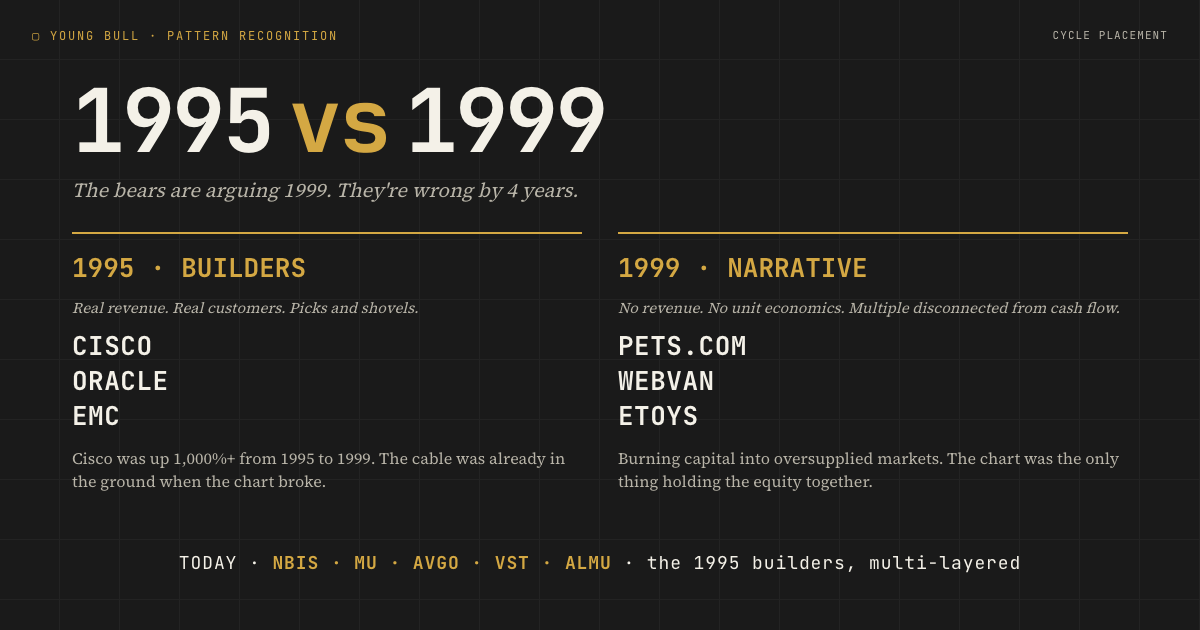
1999 was Pets.com. 1995 was Cisco.
The pattern recognition matters. People who lived through the dot-com bubble see AI capex hitting $700 billion in 2026 across the four hyperscalers and feel the muscle memory. They are reading the chart and not the receipts.
In 1999, the canonical bubble names were Pets.com (no revenue), Webvan (negative unit economics), eToys (unscalable cost structure). The names that survived were Cisco (40% gross margins selling networking gear), Oracle (databases that ran the back office), EMC (storage that everyone needed). Cisco was up over 1,000% from 1995 to 1999 and the cable was already in the ground when the bubble broke.
We are at the 1995 part of the cycle. The infrastructure layer is being built. The companies selling picks and shovels have actual revenue, contracted backlog, and negative working capital because customers are prepaying.
Receipts.
NBIS reported Q1 2026 revenue of $399 million this morning. Up 684% year over year. The Nebius AI segment alone did $390 million at a 45% adjusted EBITDA margin. The 2026 capex guide raised to $20 to $25 billion. A 1.2 GW Pennsylvania site secured. That is a real business with real customers (Microsoft, Meta) signing contracts denominated in tens of billions.
Micron’s HBM business has a multi-year sold-out book. The stock did what a sold-out book does.
AVGO has a $73 billion custom AI silicon backlog (Google TPU, Meta MTIA, OpenAI working with them). Custom silicon is the part of the AI stack that hyperscalers cannot buy from NVIDIA at any price.
VST has the largest US nuclear fleet outside Constellation. Microsoft signed a 20-year power purchase agreement with VST for nuclear capacity. Meta did the same. Behind-the-meter nuclear is the only way certain hyperscaler workloads can come online before 2030.
ALMU is shipping indium phosphide quantum-dot photonic ICs. NASA contract plus six government R&D programs is the floor. Photonics is the part of the stack that becomes load-bearing as inference workloads displace training workloads.
These are not Pets.com.
People keep asking who the Cisco of AI is. The answer is there are many Ciscos this cycle because the Physical Layer has more layers. Compute and memory. Datacenters. Power and grid. Photonics. Networking. Cooling. Defense AI. Test and materials. The next 20 years of compounding will not come from one stock. It will come from picking five to ten Ciscos across eight layers and not blinking when the chart moves.
What would have to break.
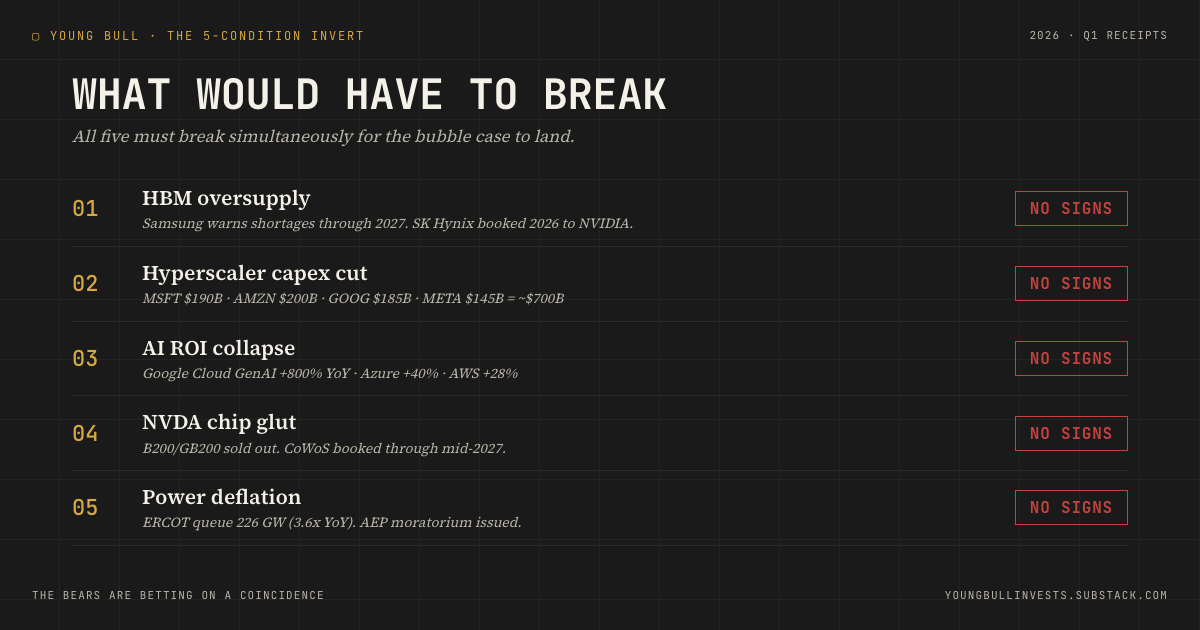
Five conditions. All must break simultaneously for the bubble case to land. Run the list.
One. HBM oversupply. Micron, Samsung, and SK Hynix would all need to guide oversupplied within the same quarter. Today they all guide undersupplied through 2027. Probability over the next four quarters: low.
Two. Hyperscaler capex cut. The four hyperscalers would need to reverse the 2026 capex guides simultaneously. Microsoft is at $190 billion. Amazon at $200 billion. Alphabet at roughly $185 billion. Meta at $115 to $145 billion. Combined around $700 billion, nearly double 2025. A cut would require either AI ROI failure or a recession-driven shock to operating cash flow. Neither is on the page yet.
Three. AI ROI collapse. Enterprise AI revenue would need to inflect down. Today it is accelerating. Google Cloud’s GenAI products grew 800% year over year in Q1 2026. Azure was 39%. AWS was 28%. Sundar Pichai said on the call that AI is now the largest tailwind for cloud and the primary growth driver for the first time. ROI is not collapsing. ROI is compounding.
Four. NVDA chip glut. NVDA would need a 12-to-18-month inventory build. Today the B200 and GB200 are sold out, the Rubin and B300 generations are pre-allocated into 2027, and the CoWoS packaging bottleneck means even if NVDA wanted to flood the market it couldn’t.
Five. Power deflation. Power prices would need to drop and queue times shorten. Today queue times are extending and AEP just issued a moratorium on new data center service requests. Vistra and Constellation contracts are tightening, not loosening.
For the bubble case to land, all five have to break at once. The base rate for five low-probability conditions converging in the same quarter is structurally low. The bears are betting on a coincidence statistics doesn’t hand out very often.
The time-horizon arbitrage.
A 17-year-old’s optimal exposure is structurally different from a 55-year-old’s. A boomer near retirement has a 10-to-15-year horizon and should care about drawdowns. A young investor has a 50-year horizon and should care about exposure to multi-decade buildouts. The interest rate at which those two groups discount future cash flows is not the same.
Boomers selling at peaks is rational behavior for boomers. Young investors selling at peaks is mathematically insane unless the underlying thesis is broken. The underlying thesis is on the receipts page below.
Buffett has a line about being greedy when others are fearful. The full version should read: be greedy when others are fearful AND the thesis hasn’t broken. Greed without thesis discipline is gambling. Discipline without greed is paralysis. Both fail.
The math says max exposure now, trim only when the discipline rules fire, and let it compound.
The receipts.
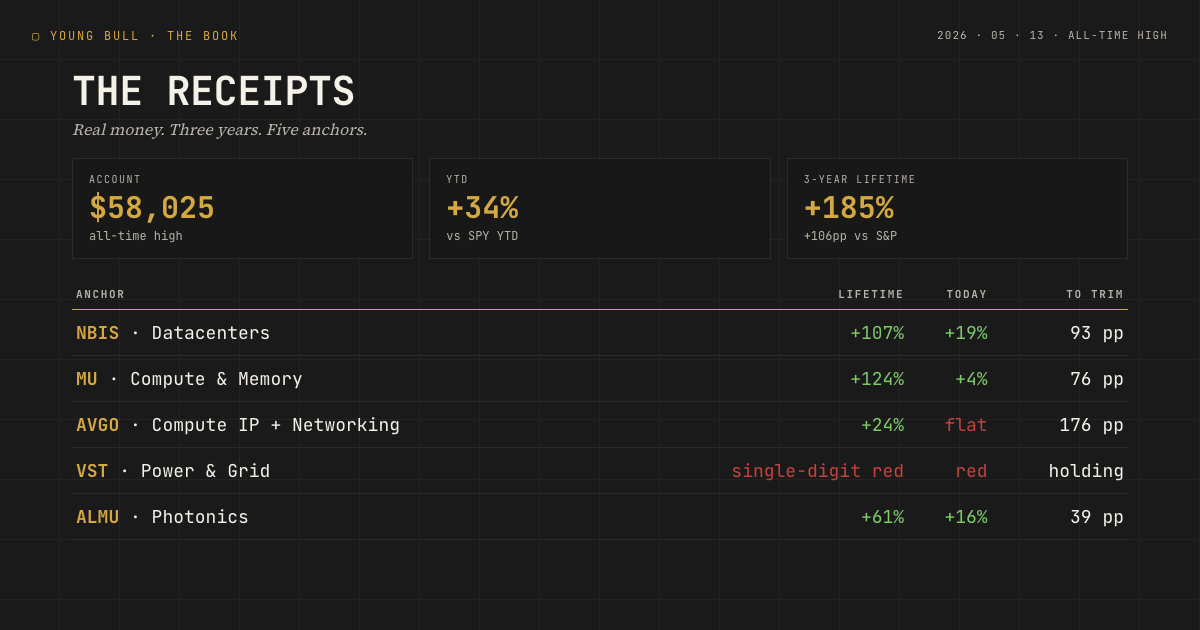
Account at all-time high today. $58,025. Up 34% year to date. Up 185% over the three years I have run this book. That is 106 percentage points of outperformance versus the S&P over the same window.
Anchor positions and where they sit.
NBIS reported earnings before the bell today. Position lifetime +107%, today +19%. The Q1 print fired the beat-and-raise branch of the decision tree I published yesterday.
MU is the HBM trade. Position lifetime +124%, today +4%. The sold-out book is doing what a sold-out book does.
AVGO is the custom silicon and networking dual-layer trade. Position lifetime +24%. The $73 billion custom AI silicon backlog is the receipt.
VST is the nuclear power trade. Position currently underwater, single-digit red. Holding through the regulatory pendulum because the long-dated PPAs from Microsoft and Meta are intact and the infrastructure is irreplaceable.
ALMU is the photonics and quantum trade. Position lifetime +61%. NASA contract plus six government R&D programs is the floor. The product roadmap to commercial laser shipping in FY27 is the upside.
I own MU, NBIS, AVGO, VST, and ALMU. The book on the portfolio page shows everything else. I do not own every name I write about. The book is the book.
The discipline.
Trim triggers are pre-set in the architecture locks. Anchors trim 25% of position at +200% lifetime. NBIS sits 93 percentage points from the trigger. MU sits 76. AVGO sits roughly 176. ALMU sits 39 (its trigger is +100%, lower bar for the smaller-cap photonics name). None has fired. None is close to firing this week.
I am not adding at these prices. The discipline rule says position size does not change inside 24 hours of a binary catalyst, and the rule extends to chasing parabolic gaps. I am not chasing the post-print pop on NBIS. I am not adding to MU on the HBM rip. I am not pulling capital out of VST because it is single-digit red.
I am holding the book. The framework decides on the tape, not on the day.
The closer.
This is the biggest infrastructure build of my lifetime. The receipts say the supply chain is undersupplied across every input that matters. The history says we are at 1995, not 1999. The math says my optimal exposure is high.
I am 17. My runway is 50 years. The Physical Layer of AI is generational.
I am not selling.
Real money. Real positions. Real receipts.
Enjoy your analysis and candor on AI buildout then I read this and don’t know which direction is correct.
https://theblackswanfiles.substack.com/p/data-centers-fools-with-other-peoples?r=25ljdv&utm_medium=ios